
LET'S BECOME ICF PCC COACHES!
All we need to do to become Professional ICF Coaches is to say less. Sounds straightforward enough, right?
But why is it not easy to do?
We need to become an Unconsultant.
The following is a bespoke course created in reference to ICF Competency and Ethical guidelines, observations and learnings from real coaching sessions, and a review of the Situational Judgment Test (SJT) format used by the ICF in its PCC/MCC exam. Each “Episode" contains a mix of videos, text, infographics, and deep dive podcasts to reinforce the concepts and lessons that will help us pass the ICF exam. Once we pass, we're immediately PCC's! Start here:
EPISODE 1
The Consultant’s Curse & The Advice Trap
The Strategic Liability of the Expert Brain
To excel at the level of Deloitte, the boardroom, or within the rigorous architecture of an EdD program, one must be a "Fixer." Bryant, your trajectory—defined by high-level strategy, doctoral research, and an MBA—has precision-engineered your brain to scan for gaps, synthesize chaos into order, and deliver high-value deliverables with authoritative speed. In the world of executive consulting, this is your competitive advantage. However, in the crucible of the ICF PCC markers, this same "Expert Ego" becomes a strategic liability.
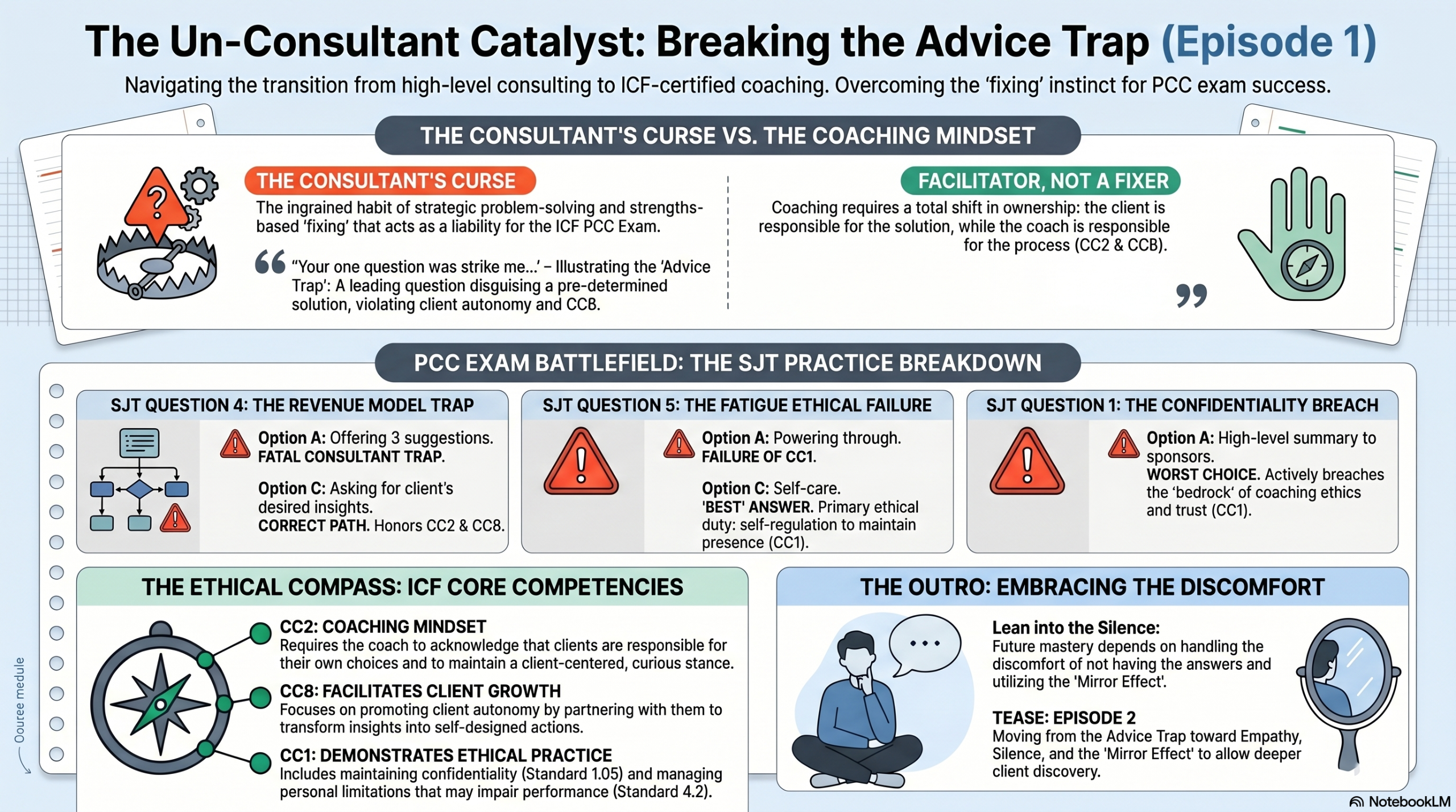
Welcome to Episode 1 of "The Un-Consultant Catalyst." This journey is designed to navigate the specific intellectual friction of your transition. For a professional of your caliber, the primary obstacle is not a lack of skill, but the seductive trap of competence. The "Consultant’s Curse" is the compulsive need to add value through solutions—a form of process impatience that violates Core Competency 2: Embodies a Coaching Mindset. To pass the PCC, you must dismantle the instinct to be the architect of the client’s answer and instead become the facilitator of their discovery. We are moving from "intellectual colonization"—where you impose your mental maps on the client—to a partnership of pure evocative awareness.
The Anatomy of a Disguised Suggestion
In high-stakes coaching, "clean" questioning is the ultimate tool for client autonomy. For the seasoned consultant, the "Advice Trap" rarely looks like a directive; it manifests as a leading question or a synthesized observation that closes the client’s field of discovery.
In a standard of excellence, we look for what Reetika achieved in her session with Shilpa, where the client remarked: "your one question was strike me..." That is the " Facilitator’s Strike"—a question so untethered from the coach’s ego that it forces a neurological pivot in the client. Unfortunately, your session with Shilpa (May 7) revealed moments where the "Deloitte Brain" prioritized speed and "deliverables" over the client’s internal processing.
The "Fear" Blunder: Labeling vs. Mirroring
The most critical technical error in your session occurred when you introduced a heavy emotional label that the client had not yet claimed.
The Exchange (Source Context 39:40):
Bryant: "All right. So where's that fear now?"
Shilpa: "It's gone. It's not even existent."
While this led to a "shift," it was a coach-led shift. According to the transcript and PCC markers, Shilpa had described her state as "anxiety," "stress," and "overwhelm." By introducing the word "fear," you performed a "Consultant Synthesis." It seems you interpreted her reality rather than mirroring it. Under CC 6.3 and 6.4, a PCC coach must notice and explore the client’s energy without imposing their own vocabulary. When you name the emotion, you own the insight; when the client names it, they own the transformation.
The "What" vs. The "Who": The Post-it Note Trap
You identified Shilpa’s mention of Post-it notes and steered her toward them as a structural solution (Transcript 28:50). This is the "Consultant’s deliverable" mindset. You focused on the "What" (the notes/the system) and missed the "Who" (the artist’s need for freedom and the "knowing-doing gap").
|
Competency |
Principle |
The "Consultant" Violation |
The "Facilitator" Masterstroke |
|
CC 2: Coaching Mindset (2.01) |
Client as Responsible |
Assuming the client needs your "expert" synthesis to find order. |
Trusting the client’s "artist" brain to find its own anchor. |
|
CC 7: Evokes Awareness (7.03) |
Explore way of thinking |
Leading the client to a "Post-it note" strategy you identified. |
Asking: "What does structure feel like to an artist who loves freedom?" |
|
CC 8: Facilitates Growth (8.03) |
Promotes Autonomy |
Solving the "What" (the desk) to provide immediate relief. |
Exploring the "Who" (the fear of being perfect for everyone). |
The Neurological Cost: When you provide the solution or the label, the client’s prefrontal cortex ceases its heavy lifting. You provide a temporary "fix," but you reduce their long-term self-efficacy.
Dissecting the Logic of the ICF Exam
The Situational Judgment Test (SJT) measures your ability to resist the "fixer" impulse. The exam rewards the process of discovery over the result of a solution.
Question 4: The Strategic Revenue Trap
A client asks you to review a business plan, citing your strategy background.
- Worst Action (Option A): Offering 3 specific suggestions. This is the "fatal consultant trap." It violates CC 1.06 (Maintaining distinctions) by shifting into consulting.
- Best Action (Option C): Asking what insights they hope to gain. This maintains the coaching container.
|
Expert/Consultant Response (Option A) |
Professional Coach Response (Option C) |
|
Focus: Viability of the revenue model (The "What"). |
Focus: The client's thinking process (The "Who"). |
|
Violation: CC 1.06 and 8.03 (Stealing Autonomy). |
Adherence: CC 2.01 and 7.04 (Evoking Insight). |
Question 10: The Silence Failure
A client is struggling to find words and pausing for long periods.
- The Bryant Trap (Option C): Asking "Are you stuck?" to facilitate.
- The PCC Mandate (Option B): Remain silent and hold the space (CC 5.07). Your MBA brain views silence as "dead air" that needs to be "managed." The PCC brain understands that silence is neurological processing time. By asking if they are stuck, you interrupt the client's internal rewiring and force them to manage your discomfort.
Question 5: The Martyrdom Error (CC 2.07)
You are exhausted and slipping into advice-giving.
- The Trap (Option A): Powering through. The "Deloitte Mindset" rewards this, but in coaching, it’s an ethical failure.
- The Best Action (Option C): Self-care and capacity evaluation. Under CC 2.07, mental well-being is a prerequisite for "Listening Actively" (CC 6). Cognitive depletion leads directly to the "Advice Trap."
Question 1: The Confidentiality Crisis (CC 1.05)
A sponsor asks for a detailed summary of a manager’s progress.
- The Strategic Failure (Option A): Providing a "high-level summary."
• • The ICF Mandate: Under CC 1.05 and Code of Ethics Section 2.1, confidentiality is absolute. Even a "strategic" summary destroys the "Trust and Safety" (CC 4) necessary for the client to be vulnerable.
From Fixer to Facilitator
Bryant, your value as a PCC coach is not in what you know, but in what you enable the client to discover. When you provide the answer, the learning stops. When you ask the evocative question and hold the silence—even when it itches—the client’s brain begins the rewarding work of self-evolution.
The 3 Non-Negotiable Shifts for a PCC Mindset
- Abandon the Solution: If you think you know the answer to the client's problem, you have stopped coaching and started "intellectual colonization."
- Mirror, Don’t Synthesize: Use the client’s exact vocabulary (CC 4.02). If they say "anxiety," do not upgrade it to "fear" unless they lead you there.
- Respect the Silence: Stop treating silence as a gap to be filled. See it as the space where the client is doing the work you cannot do for them (CC 5.07).
Coming up in Episode 2: "Empathy, Silence, and the Mirror Effect." We will dive into the agonizing discomfort of the "Mirror Effect"—how to reflect the client’s energy shifts (like Shilpa’s "artist" realization) without the "Expert Brain" jumping in to "save" them from their own brilliance.
Bryant, you have the intellectual horsepower. Now, take your foot off the accelerator and let the client lead the drive.
Stay curious.
EPISODE 2
Empathy, Silence, and the Mirror Effect
Transitioning from Efficiency to Presence
This analysis deconstructs the psychological friction inherent in the transition from the "Fixer" archetype to a professional coaching presence. For the high-performing consultant, the shift toward silence is not merely a change in pace; it is a direct threat to a professional identity built on being a "source of answers." This "Consultant’s Curse" drives a pathological perspective—an instinctive urge to diagnose a client’s "disorder" and provide a cure.
Mastery requires a shift to the Dimensional Approach, viewing mental health and performance on a spectrum of function rather than a binary of health versus pathology. This transition is technically demanding because it requires the coach to navigate the "terrifying" vacuum of the unknown. Where the MBA brain sees silence as "dead air" or a failure of momentum, the Senior Behavioral Analyst recognizes it as the prerequisite for neural rewiring. To enter the PCC (Professional Certified Coach) tier, one must abandon the drive for transactional efficiency and master the discipline of being a clean, non-interfering mirror.
The Mirroring Trap: Interpreting vs. Reflecting
Core Competency 6 (Listens Actively) demands that a coach reflect the client’s internal world without the interference of the coach’s own map. A "clean mirror" reflects exactly what is present; an interpreted mirror distorts the image by adding the coach’s vocabulary, labels, and syntheses.
Transcript Analysis: Bryant & Shilpa
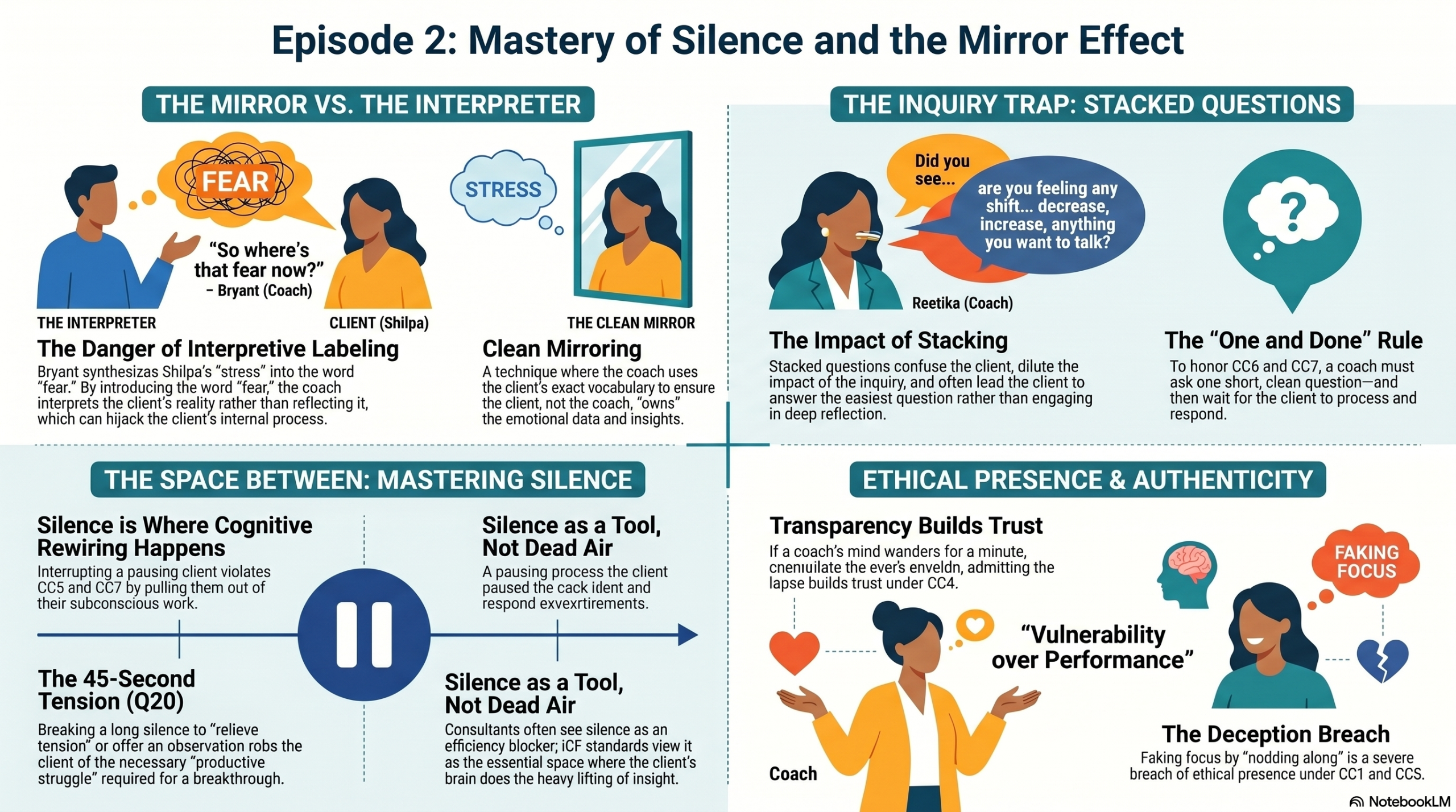
At 39:40, the coach asks: "So where's that fear now?"
A surface-level review might applaud this as a perceptive emotional inquiry. However, a technical deconstruction of the Module 2.2 source reveals a significant PCC-level breach. While the client, Shilpa, did use the words "fear fear" earlier in the session (around 20:10) when discussing a childhood memory of a basement, the context at 39:40 was entirely different. Immediately preceding the coach's question (at 38:40), Shilpa was describing a state of "freedom" and "taking care of herself."
By re-introducing the word "fear" as a label for her current state, the coach performed a "What" activity—interpreting the client's past data to synthesize a present state—rather than reflecting the "Who" in the moment.
The Violation: The coach "upgraded" the client's current expressions of "stress" (0:12) and "freedom" (38:40) to the coach's chosen label, "fear."
The Standard: To pass the PCC exam, you must act as a perfectly clean mirror. Under CC 6.3, the coach must inquire into what the client is communicating rather than labeling it for them.
The Distinction: At the ACC (Associate) level, this is often graded as a "perceptive nudge" that moves the session forward. At the PCC level, this is a leading intervention. The coach has seized ownership of the insight, robbing the client of the opportunity to name their own emotional shift.
The "So What?" Layer
When a coach labels a client’s emotion, they impose their own cognitive map. This forces the client to navigate the coach's world rather than their own. Professional mastery requires the coach to remain in the "space of not knowing" (CC 5.06), asking "What is that feeling?" and allowing the client the autonomy to define their own experience.
Diluting Awareness: The Issue of Stacked Questions
Core Competency 7 (Evokes Awareness) is effectively neutralized when a coach "stacks" questions. Stacking occurs when a coach delivers multiple inquiries in a single breath, forcing the client into Level 1 Listening (internal processing) to decide which question to answer, rather than Level 2/3 Presence.
Transcript Analysis: Reetika’s Inquiry
At 42:32, the inquiry was: "Did you see are you feeling any shift... decrease, increase, anything you want to talk?"
This contains three distinct inquiries:
- Binary Check: Did you see/feel a shift?
- Directional Measurement: Did it decrease or increase?
- Open Prompt: Is there anything you want to talk about?
The "So What?" Layer
Stacked questions provide the client with a cognitive "escape hatch." Faced with three paths, the brain naturally selects the path of least resistance—usually the surface-level or logistical question. This dilutes the session's power and prevents the client from sitting with a singular, evocative inquiry that could lead to a breakthrough. To honor CC7, the coach must ask one short, clean question and then—crucially—stop talking.
The Neural Space
Silence is a technical tool, not "dead air." In the silence, the client’s brain is most active, performing the heavy lifting of restructuring perspectives.
SJT Question 10: The Pausing Client
When a client speaks slowly and pauses (SJT Q10), the coach’s instinctual response reveals their level of mastery.
|
Consultant Instinct (The MBA Brain) |
ICF Standard (Neural Space) |
|
Action: Offer words to finish the sentence or ask "Are you stuck?" |
Action: Remain silent and hold the space. |
|
Rationale: Sees silence as a "blocker" or "dead air" to be resolved for efficiency. |
Rationale: Recognizes that interruption violates CC 5 (Maintains Presence) and pulls the client out of subconscious processing. |
SJT Question 20: The 45-Second Silence
In Question 20, the client goes silent for 45 seconds. Breaking this tension serves the coach’s ego, not the client’s growth. According to Module 2.3, breaking this silence violates CC 5 (Maintains Presence) and CC 7 (Evokes Awareness) because the tension of the pause is exactly where the brain rewires itself.
The "So What?" Layer
The coach’s discomfort with silence is a failure of presence. By holding the space, the coach demonstrates confidence in the client's resourcefulness. This shifts the focus from the coach’s "performance" to the client’s internal transformation.
Radical Transparency: The Ethics of Focus
Ethical mastery is the distinction between ACC (doing coaching) and PCC (being a coach). This is most evident when the coach’s focus lapses.
SJT Question 11: The Zoned-out Coach
Scenario: The coach realizes their mind wandered for a full minute.
- The Breach: Option A (Faking focus) is a severe ethical violation. It contradicts CC 1.01, which demands personal integrity and honesty.
- The Standard: Option B (Admitting the lapse) aligns with CC 4.06: "Demonstrates openness and transparency as a way to display vulnerability and build trust."
The "So What?" Layer
Radical transparency destroys the "expert" facade and strengthens the partnership. By admitting a human error, the coach models the very vulnerability they ask of the client, fostering a relationship built on reality rather than professional artifice.
The Discipline of the Pause
The technical theme of this episode is The Discipline of the Pause. Mastery is found in the restraint required to remain a clean mirror, the patience to avoid stacking questions, and the ego-management required to hold a 45-second silence.
Three-Point Checklist for Professional Mastery
- The 3-Second Rule: After a client finishes speaking, count to three before responding. This allows the client to fill the vacuum with their own deepest insights.
- Verbatim Mirroring: Do not "upgrade" or synthesize. If the client says "stressed," do not reflect back "anxious" or "fearful." Use their exact vocabulary to maintain a clean mirror.
- Singular Inquiries: Ask one concise question. If you find yourself adding a second, stop. Let the first question do the work.
Coming Up in Episode 3: The Therapy Red Line Next, we explore the "Therapy Red Line" and the "Pathological Perspective." We will analyze the technical indicators for referral, how to manage deep emotional shifts without "fixing" them, and the ethical boundaries that separate professional coaching from psychotherapy.
EPISODE 3
Ethics, Boundaries, and the Therapy Red Line
Ethics as the Professional Shield
In the high-stakes environment of professional coaching, ethics and boundaries are frequently misunderstood as mere administrative constraints or bureaucratic red tape. From the perspective of an ICF Master Certified Coach and ethics auditor, these standards constitute a non-negotiable governance framework—the strategic "protective shield" of our profession. Maintaining the scope of practice is not simply a matter of compliance; it is a critical exercise in managing strategic liability. When a coach oversteps into the clinical domain, they don’t just risk the client’s well-being; they jeopardize the integrity of the entire ICF ecosystem and their own professional standing.
By adhering to Core Competency 1 (Demonstrates Ethical Practice), we act as the "Protectors of the Profession." This involves a rigorous commitment to maintaining the distinctions between coaching, consulting, and psychotherapy. This clarity ensures that the space we hold remains a productive environment for growth rather than a hazardous territory for unlicensed clinical intervention. Transitioning from the empathetic space-holding discussed in Episode 2, a master-level practitioner must know how to navigate the immediate life stress a client presents with, ensuring the focus remains on coachable outcomes rather than therapeutic trauma processing.
Case Study Analysis: The Art of Empathetic Redirection
Managing high-stress client intakes requires a clinical-level application of Core Competency 3 (Establishes and Maintains Agreements). The coach’s primary responsibility at the start of a session is to partner with the client to identify the specific outcome for the time they have together. Without this strategic pivot, the session can quickly devolve into a "trauma-dump" that the coach is neither qualified nor ethically permitted to manage.
The Pivot: Analyzing Bryant and Shilpa
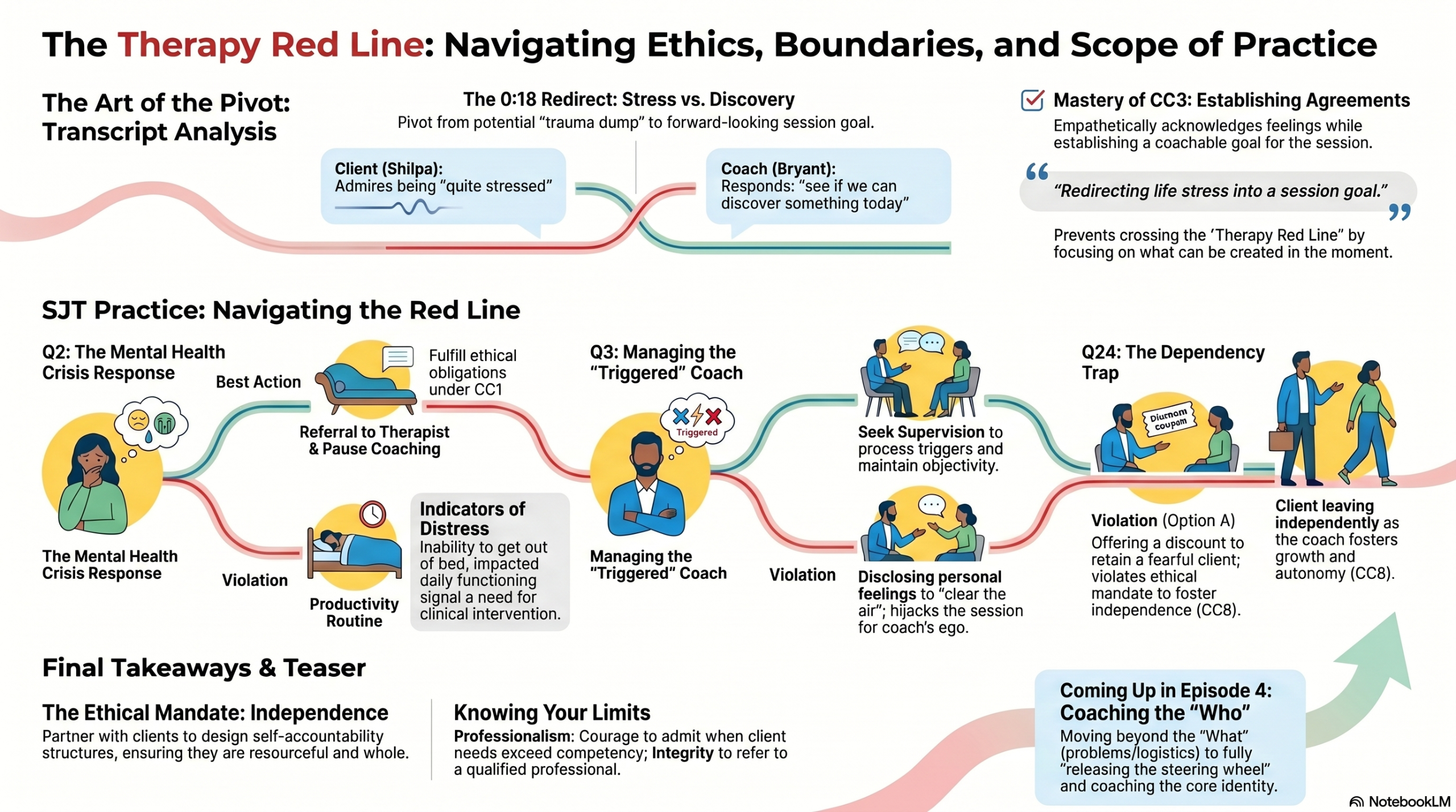
In the session between Bryant and Shilpa, we observe a masterful boundary management technique. After Shilpa reports feeling "quite stressed" in her life, Bryant responds at the 0:18 mark:
"Oh. Well, maybe that's something that, you know, I'd love to try to help. Um, see if we can discover something today."
Bryant stays firmly within the bounds of CC 3.06 by narrowing the focus to what can be accomplished "today." He acknowledges the current business overwhelm and the deeper emotions behind it—recognizing Shilpa’s "artist" identity—but he prevents the session from drifting into an unstructured venting of life stress. By partnering with the client to create a session-specific agreement, he moves the client from a state of general paralysis toward a specific, coachable focus on structure and organization. This redirection is essential; however, a coach must remain diagnostic in their observation. If stress signals cross into the clinical threshold, redirection must be replaced by a professional referral.
The Therapy Threshold
The "Therapy Red Line" represents a hard boundary regarding professional liability. When a coach encounters clinical indicators of distress, they are ethically mandated to stop coaching and refer the client to a mental health professional. According to the ICF Referral Guide, the ultimate differentiator is the client's level of daily functioning. When a client's internal state prevents them from performing self-care, work, or social duties, the situation has moved beyond the scope of coaching.
Situational Judgment Test (SJT) Breakdown: Question 2
The scenario involves a client revealing they have struggled to get out of bed, felt hopeless, and cried daily for the past month—a clear indication of impairment in daily functioning.
|
Best Action (Option B) |
Worst Action (Option C) |
|
Referral/Pause: Suggest the client visit a medical professional or therapist and pause coaching if necessary. |
Rigorous Routine: Partner with the client to create a daily routine to build momentum. |
The "So What?" Layer: Practicing Therapy Without a License Mastery requires recognizing that Option A (exploring the context of "hopelessness") is not just a weak coaching choice—it is dangerous. In the presence of symptoms like persistent crying and an inability to function (indicators defined by duration, frequency, and intensity over several weeks), "exploring" is a violation of ICF Code of Ethics Section 4.2. It constitutes practicing therapy without a license. Engaging in past trauma or clinical pathology under the guise of coaching is a breach of CC 1.06 (Maintaining distinctions) and CC 1.07 (Referring).
The Mirror of the Coach: Triggers and Professional Supervision
A coach’s internal state is the primary boundary for maintaining professional presence. Core Competency 2.10 demands that the coach remain aware of the influence of their own thoughts and behaviors on the client. When a coach becomes internally triggered, they lose the capacity to be an objective partner.
SJT Breakdown: Question 3 (The Triggered Coach)
In this scenario, a coach feels triggered by a client’s political or social views.
- Critical Evaluation of Option A: "Clearing the air" by disclosing the coach's feelings is a disastrous breach of professional presence. This centers the coach’s ego and emotional comfort over the client’s needs. It burdens the client with the coach’s internal conflict, shattering the "safe, supportive environment" required by CC 4.
- The Supervision Framework: Option B (Seeking supervision or mentor coaching) is the professional requirement. A coach must use reflective practice (CC 2.03) and manage one's emotions (CC 2.06) to process external triggers.
Impact Analysis: A triggered coach compromises the "Co-Creating the Relationship" domain by:
- Presence (CC 5): Becoming focused on internal dialogue rather than being "observant and responsive" to the client.
- Trust (CC 4): Subtly challenging the client’s values, violating CC 4.02, which requires respect for the client’s perceptions and style.
Fostering Autonomy: The Dependency Trap
The ethical mandate of coaching is to foster client independence, moving them toward self-efficacy rather than reliance. This is the clear line between a "Consultant’s Brain" and an "ICF Ethical Mindset."
SJT Breakdown: Question 24 (The Dependency Trap)
The scenario involves a client nearing the end of an engagement who expresses uncertainty about maintaining progress without the coach.
The "Consultant’s Brain" (Worst Action - Option A): Offering a discounted package to retain the client is the worst action. This prioritizes the coach’s revenue over the client’s autonomy (CC 8.03). It capitalizes on the client's fear and cultivates a dependency that violates Section 3.23 of the Code of Ethics, which encourages coaches to suggest other resources if the client would be better served.
The ICF Ethical Mindset (Best Action - Option B): The coach must partner with the client to design a self-accountability structure. This aligns with CC 8.05: "Invites the client to consider how to move forward, including resources, support, and potential barriers."
Checklist for Fostering Independence (CC 8.05):
- Has the client identified their own post-session reflection and support systems?
- Have we identified external resources (not just the coach) for ongoing growth?
- Does the action plan focus on building the client's self-concept as a capable actor?
Releasing the Steering Wheel
The ultimate mark of professional mastery is the wisdom to know when to let a client go or when to refer them to a more appropriate professional. This is the embodiment of the "DO GOOD" principle (Standard 5.3) in the 2025 ICF Code of Ethics. Every time a coach respects the "Therapy Red Line," manages their internal triggers through supervision, and resists the temptation to foster dependency, they act as a Protector of the Profession.
Knowing your limits is the highest form of integrity. It protects the client, the coach, and the global reputation of the coaching community.
Closing Thought: Professional mastery requires the courage to be "the guide on the side," not the "sage on the stage." When we release the steering wheel, we allow the client’s genius to take the lead. Each boundary maintained is a victory for the integrity of our craft.
Coming up in Episode 4: We will explore the shift from coaching the "What" (logistics) to coaching the "Who" (identity, beliefs, and values), and how to navigate a client’s internal landscape for transformational breakthroughs without crossing the therapy line.
EPISODE 4
Designing the "Who" and Releasing the Wheel
The Conceptual Leap from "Fixer" to Partner
For the high-achieving consultant, manager, or executive, International Coaching Federation (ICF) credentialing represents more than a skills upgrade; it is an existential threat to their professional identity. For decades, your value has been measured by your ability to provide the "right" answer. In this context, silence feels like a failure, and "releasing the wheel" feels like a reckless abandonment of your responsibility. In Episode 3, we explored the ethical boundaries required to keep the client safe. However, safety is merely the floor. To move toward Professional Certified Coach (PCC) mastery, we must transition from keeping the client safe to empowering the client.
This is the hardest conceptual leap: shifting focus from the "What" (the tactical problem) to the "Who" (the human being). High-achievers equate "fixing" with "value," but a true coaching partnership requires the analytical rigor to identify the underlying human patterns that make the tactical problem possible in the first place. Releasing the wheel is not a passive act; it is a sophisticated, intentional choice to honor the client’s supreme expertise over their own life.
Deconstructing the Hierarchy in Coaching
High-achievers instinctively default to a "managerial" style. In a corporate setting, setting deadlines and assigning tasks is efficient. In a coaching container, it is a hierarchy error. When a coach takes on the role of the "approver," the client becomes a "reporter." This "Consultant’s Curse" creates a parent-child dynamic that destroys the partnership essential for PCC-level coaching.
Consider the interaction in the "Shilpa coaching Reetika" transcript at 42:01:
|
Quote/Behavior |
ICF Violation |
|
Shilpa: "You're gonna take one good video and by when you're going to do that?" |
CC8: Facilitates Client Growth. Specifically, it violates CC 2.01 (Coaching Mindset), which requires the coach to acknowledge that clients are responsible for their own choices. By dictating the "by when," the coach inherits the responsibility for the client's failure. This also undermines CC4 (Trust and Safety) by shifting the relationship from a collaborative partnership to a directive hierarchy. |
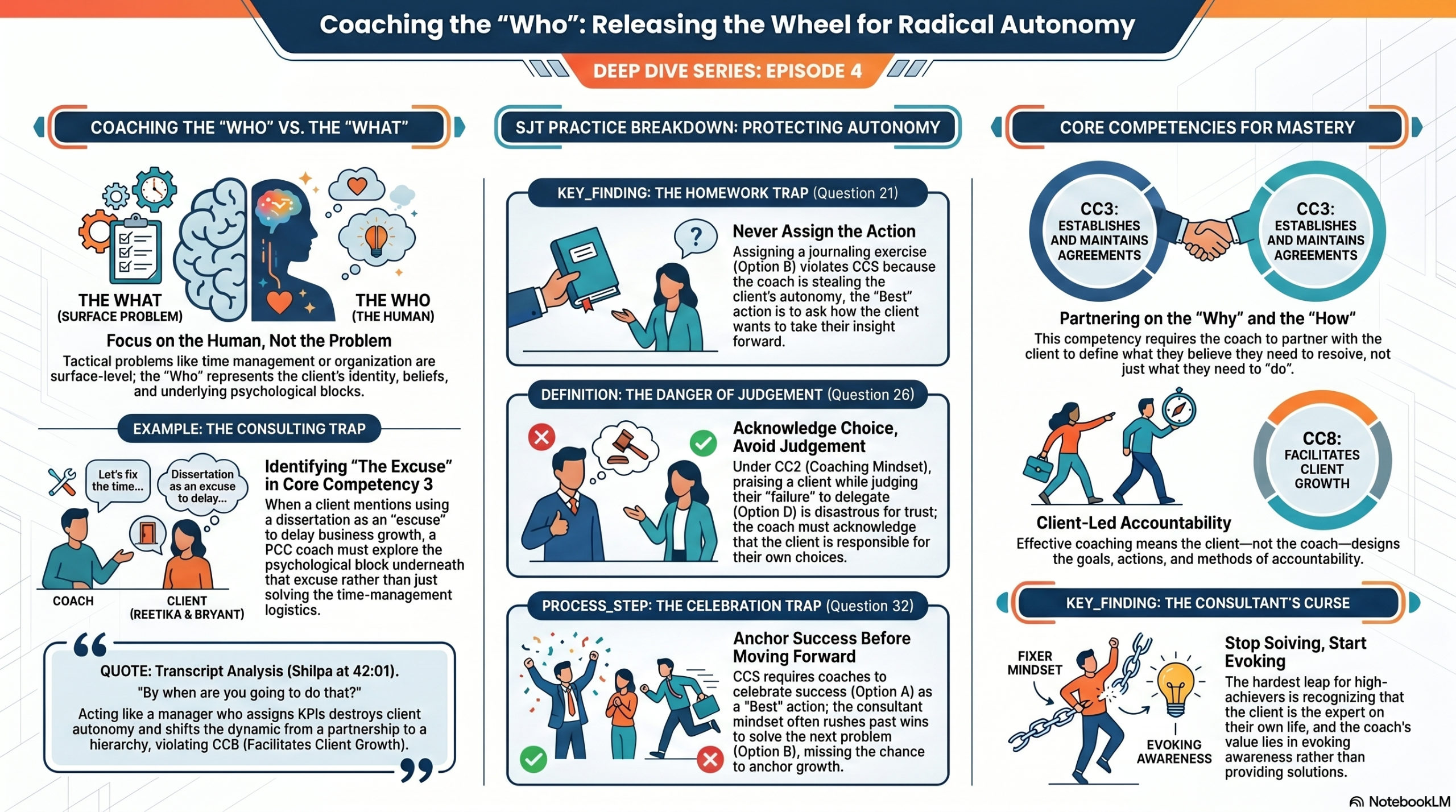
Shilpa’s directive—"by when are you going to do that?"—is a project management KPI, not a coaching inquiry. While the intent is to be helpful, the coach has effectively stolen the client's agency. Under the 2025 standards, a PCC-level coach must partner with the client to design accountability (CC 8.02). If the coach sets the deadline, they are no longer a partner; they are a supervisor. The result is a client who performs for the coach's approval rather than their own growth.
The "Who" vs. The "What": Psychological Blocks
A coach who only addresses the "What" (the surface-level logistics) is merely a high-priced secretary. To facilitate sustainable change, the coach must use CC 3.07 to "partner with the client to define what the client believes they need to address or resolve." This means looking past the tactical "time management" issue to the "Who"—the identity of the person struggling.
In the "Reetika coaching Bryant" session, a critical opportunity to address the "Who" was presented at 00:21:
Bryant: "...I also feel like I use the... doctoral dissertation as kind of an excuse to let the business stuff go later."
Reetika’s response focused on the logistics of a routine—the "What." By ignoring the word "excuse," she missed the chance to explore the underlying belief system. A consultant would try to fix the calendar; a PCC coach explores the "excuse" language as a shield for the client's identity. If you ignore the "Who," the client leaves with a plan they are psychologically unready to execute.
To unlock the "Who" in that specific moment, a coach should use Evocative Questioning (CC7) to target the identity:
- "You called the dissertation an 'excuse.' If we removed that shield, what truth are you left standing with regarding your business?"
- "Who would you have to become to stop using your academic success as a reason to delay your commercial success?"
• • "What part of your identity is protected by this 'excuse'?"
SJT Practice Breakdown: Navigating the Exam Logic
The Situational Judgment Test (SJT) is specifically designed to "catch" coaches who are secretly still trying to be helpful experts. The "Best" answer always honors client expertise.
Practice Question 21: The Homework Trap
- The Scenario: 5 minutes left in the session. The client has insight but no next steps.
- The Trap: Option B (assigning a journaling exercise). This is the "Consultant Trap." High-achievers use tangible deliverables to justify their fee, but assigning homework violates the principle of client-led design (CC 8.03).
- The Logic: Option A (Asking the client how they would like to take the insight forward) is the Best Action. It places the responsibility for action design squarely on the client, upholding the partnership.
Practice Question 26: The Delegation Failure (ICF Q2)
- The Scenario: A client fails to delegate and does the work themselves to meet a deadline.
- The Red Flag: The coach feeling "disappointment" violates CC 2.06, which requires a coach to "manage one's emotions." At the ACC level, disappointment might be seen as a "nudge"; at the PCC level, it is a judgment that destroys the container.
- The Logic: Option D (praising the deadline but judging the failure to delegate) is disastrous. It creates a parental dynamic. The Best Action is Option B: acknowledging that the client is responsible for their own choices, upholding the principle that the client is creative and whole (CC 2.01).
Practice Question 32: The Celebration Trap (ICF Q8)
- The Scenario: The client shares a major win—nominated for a leadership program by the CEO.
|
Consultant Mindset |
PCC Mindset |
|
Rushing to the next problem: "Great, what challenges do we tackle next?" (Option B). The consultant brain always wants to fix the next thing. |
Anchoring Success via CC 8.08: "Invite the client to share how they plan to celebrate." (Option A). This is the mandatory "Best" action. |
The "Consultant Mindset" will steamroll over a life-changing win to get to the next task. The PCC Mindset recognizes that anchoring the success is what allows the client to internalize their growth.

The Client as the Supreme Expert
The core doctrine of the ICF is that the client is the supreme expert on their own life. Our value as coaches lies not in the cleverness of our solutions but in our presence and our commitment to a process that evokes the client’s own wisdom. Mastering the "Who" is the key to passing the PCC exam because it demonstrates that you have finally released the wheel.
When you coach the "Who," you move beyond transactional problem-solving and facilitate what Shilpa called a "vibrational shift" in her session. You stop trying to fix people and start allowing them to transform. If you can stay in the discomfort of "not knowing" and trust the client's autonomy, you have graduated from expert to Master Coach.
Tease for Episode 5: In our final installment, we will synthesize the entire series to master the SJT Exam Logic, ensuring you can identify every "Expert Trap" and move confidently through the final PCC assessment.
EPISODE 5
A Cheat Sheet for the ICF SJT Exam
Synthesizing the Journey to Mastery
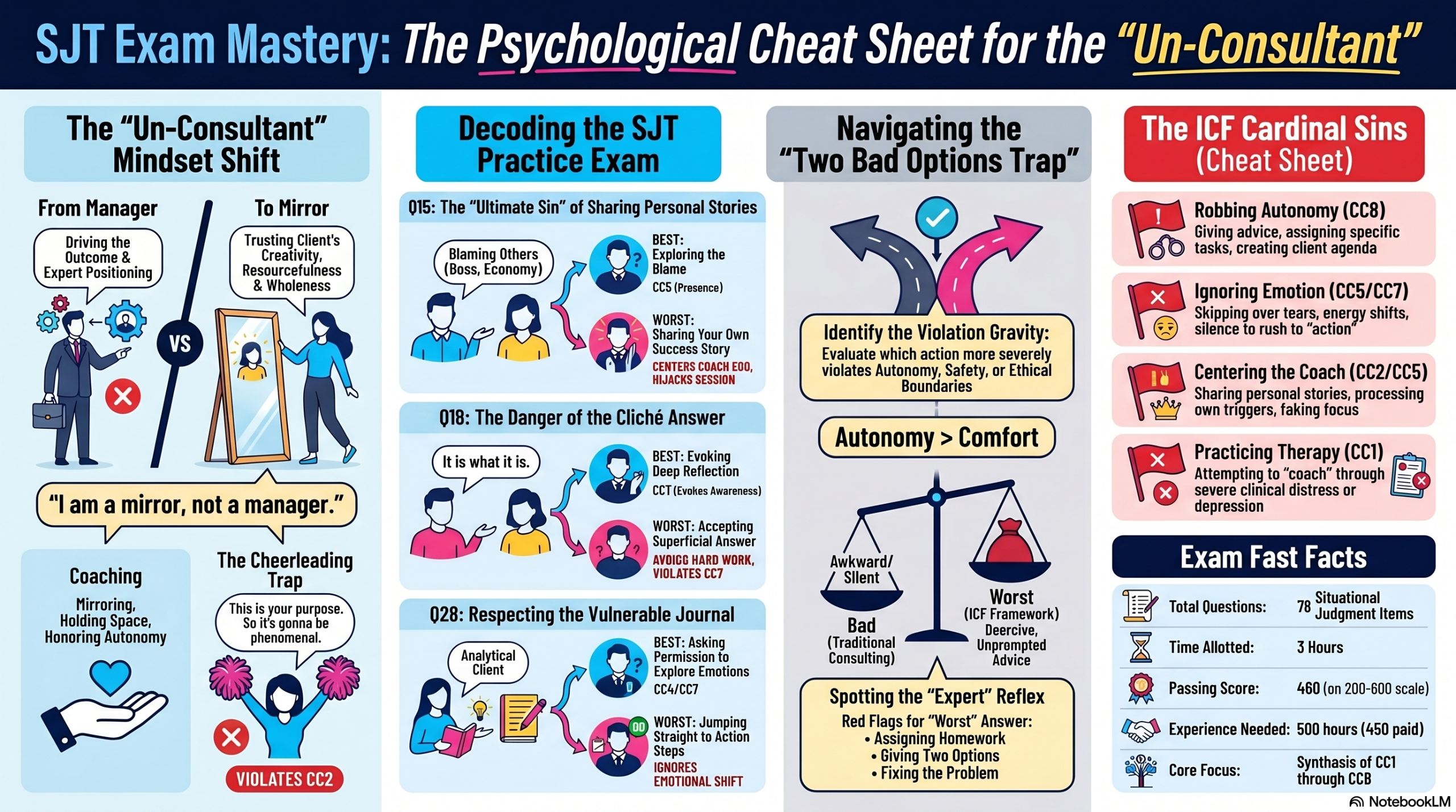
Welcome to the final installment of our "Un-Consultant" series. You have reached the summit of a journey that required a fundamental shift from tactical problem-solving to the profound psychological presence of a Professional Certified Coach (PCC). This finale is designed to bridge the gap between coaching knowledge and the specific, high-scoring reflexes needed for the ICF Credentialing Exam. The Situational Judgment Test (SJT) is not a test of your intellect or your ability to memorize frameworks like an MBA finance final; it is a three-hour, 78-question test of your professional "being." To pass with the required score of 460 or higher, you must abandon the consultant’s drive for results and embrace the coach’s commitment to process.
Before we deconstruct the exam's psychological matrix, let us reflect on your Transformation Timeline:
- The Ethical Foundation: Moving from a passive "avoiding bad" stance to an active "doing good" commitment to the ICF Code of Ethics.
- The Agreement Shift: Shifting the focus from surface-level tactical agendas ("The What") to the client’s identity and beliefs ("The Who").
- The Presence Pivot: Learning to treat silence as a diagnostic tool for awareness rather than a void to be filled with expertise.
- The Awareness Breakthrough: Transitioning from an "Expert Status" that provides answers to a "Mirror Status" that reflects the client's internal brilliance.
Our primary objective today is to rewire your intuition so you can navigate the subtle boundaries of the coaching relationship—boundaries that often separate a high-scoring master from a struggling consultant.
The "Cheerleading" Trap: Deconstructing the Boundaries of Support
In the consulting world, high-energy validation is seen as leadership; in the ICF world, it is often a "Cheerleading Trap." While excessive praise appears supportive, it fundamentally undermines client autonomy by making the coach the source of validation. When a coach validates a client’s purpose for them, they inadvertently signal that the client’s own internal compass is insufficient, thereby creating a dependency loop.
Consider Shilpa’s statement to Reetika at 42:51: "This is your purpose. So it’s gonna be phenomenal. I can't wait." Through the lens of the 2025 Core Competencies, this is a technical violation. By telling the client "this is your purpose," the coach fails to uphold Core Competency 2: Embodies a Coaching Mindset, specifically Sub-competency 2.01, which requires the coach to acknowledge that clients are responsible for their own choices. Furthermore, it bypasses Core Competency 4: Cultivates Trust and Safety, specifically Sub-competency 4.03, which requires the coach to acknowledge and respect the client's unique talents and work.
|
Cheerleading (Coach-Led Validation) |
Coaching (Client-Led Awareness) |
|
Action: Coach defines the client’s purpose or predicts a "phenomenal" outcome. |
Action: Coach asks the client how they feel about their discovery or what its impact is. |
|
Impact on "So What?": Creates a dependency loop where the client seeks external approval to feel confident. |
Impact on "So What?": Supports Sub-competency 8.01 by allowing the client to integrate new learning into their own worldview. |
|
Power Dynamic: Expert/Validator to Subject. |
Power Dynamic: Equal Partnership. |
This violation shifts the power dynamic from "Partnership" to "Expert." By attaching to the outcome, the coach ceases to be a detached observer and becomes a manager of the client's emotional state. To succeed on the exam, you must recognize that your job is to reflect the client’s energy, not to supply it.
The Anatomy of "Worst" Responses
The SJT Matrix requires you to identify both the "Best" and "Worst" actions. For the "Un-Consultant," the "Worst" answer is often the most elusive because it frequently mimics "helpful" consulting.
Practice Question 15: The Blame Cycle
When a client spends significant time blaming external factors (boss, economy) for their lack of progress:
- The Fatal Flaw: Option D (Sharing a personal story of a difficult boss) is the ultimate sin.
- The Technical Violation: This violates Core Competency 5: Maintains Presence and Core Competency 2: Embodies a Coaching Mindset. By sharing your own history, you center your ego and erase the client’s agenda. You have moved from a "Mirror" to the "Main Character."
Practice Question 19: The Cliché Barrier
When a client gives a superficial answer like "It is what it is":
- The Fatal Flaw: Option A (Accepting the answer and moving on) is categorized as the "Worst."
- The Technical Violation: This violates Core Competency 7: Evokes Awareness, specifically Sub-competency 7.02, which requires the coach to challenge the client to evoke insight. Allowing a cliché prevents the client from doing the hard work of self-discovery, effectively ending the coaching process.
Practice Question 28: The Analytical Client
In the case of the analytical client who provides a journal about social anxiety:
- The Two Bad Options Trap: You must choose between Option C (identifying tactical steps) and Option A (acknowledging emotions and asking to explore them).
- The Consultant’s Curse: A consultant will naturally gravitate toward the tactical (Option C). However, Option C is the "Worst" because it ignores the emotional disclosure. Ignoring emotion is a Cardinal Sin. The "Best" is Option A, as it honors the journal's vulnerability and follows the client's lead into their emotional state.
In summary, the "Worst" answer is almost always the one that steals autonomy, ignores an emotional shift, or centers the coach’s ego.
The Cardinal Sins: Spotting the Fatal Flaws
The ICF penalizes specific behaviors based on a psychological logic that prizes client-centeredness above all. To maximize your score, apply the following "Reflex Corrections" when you spot these sins in exam scenarios.
- Robbing Autonomy: Giving advice, assigning homework, or limiting a client’s options.
- Reflex Correction: Invite the client to design their own actions and accountability (CC8).
- Ignoring Emotion: Skipping over tears, energy shifts, or vulnerability to reach an "action plan."
- Reflex Correction: Pause, acknowledge the shift, and ask if the client wishes to explore it (CC6).
- Cheerleading or Judging: Validating the client’s purpose or subtly criticizing their progress.
- Reflex Correction: Maintain a neutral, curious mindset and reflect the client’s observations back to them (CC4).
- Making it about the Coach: Sharing personal stories, processing your own triggers, or using your own vocabulary.
- Reflex Correction: Use the client's exact words and keep your personal history out of the room (CC5).
- Practicing Therapy: Attempting to "fix" clinical issues or deep-seated trauma.
- Reflex Correction: Assess whether the issue interferes with daily functioning (work, self-care) and refer the client to a mental health professional if they lack the internal resources to move forward (CC1).
The Heuristic for the "Two Bad Options Trap"
When choosing between two negative outcomes, use this decision tree to identify the "Worst" answer, keeping the "Consultant’s Curse" (the urge to fix or lead) in mind:
- Level 1 (Fatal): Does the action violate client safety, confidentiality, or ethics? (Always Worst)
- Level 2 (Severe): Does the action rob the client of autonomy or center the coach's ego? (Extremely Bad)
- Level 3 (Minor): Is the action merely awkward, abrupt, or a missed opportunity? (Less Bad)
Ultimately, the exam tests your ability to remain a detached, curious partner rather than a results-driven manager.
Logging Success and the Un-Consultant Transformation
As you finalize your preparation for the PCC credential, you must match your psychological shift with logistical precision. The credentialing process is a marathon of evidence that proves you have evolved from a "Manager" to a "Mirror."
The PCC Application Checklist
- Log 500 Hours: A minimum of 450 paid hours, with at least 50 hours occurring within the 18 months prior to application, across at least 25 different clients.
- Performance Evaluation: Submit two audio recordings of coaching sessions with verbatim transcripts that demonstrate PCC-level markers.
- Staff Review: Allow up to 18 weeks for the ICF to complete the performance evaluation review.
- The Exam: Complete the 3-hour SJT and achieve a passing score of 460 or higher.
The strategic mantra for your final hours of study is: "I am a mirror, not a manager." Managers are responsible for results, timelines, and "phenomenal" outcomes. Mirrors are responsible only for the clarity of the reflection. When you stop trying to manage the client's progress, you finally grant them the space to achieve it.
You have rewired your reflexes. You have learned to trust the silence and honor the client's internal resources. Do not treat this as an "MBA finance final"; trust the intuition you have built over these five episodes. Go into that exam and demonstrate the "being" of an MCC. You are ready to pass with flying colors.